

Last Updated: October 30, 2026
Quick Summary
To avoid errors on personalized wooden gifts, capture the customer's exact text in writing, build the proof from that source, and require explicit written approval before cutting. Run a pre-production checklist covering spelling, dates, layout, wood species, and a test engraving on the same wood. Lock the approved file so any later change needs a new proof.
- Errors start with customer details, wood selection, layout and font choices, and machine settings.
- Engrave across the grain and keep lettering away from knots and surface defects.
- Read names and dates aloud, character by character, and have a second person check.
- Test laser power and speed on scrap of the same species before touching the real piece.
- Treat a wrong name as a remake, not a repair, since sanding leaves a ghost of the cut.
Table of Contents
- Why Personalized Wooden Gifts Go Wrong (and Where Errors Start)
- Choosing Wood That Engraves Cleanly: Species, Grain and Knots
- A Personalized Gift Engraving Proof Checklist Before You Approve
- How to Proofread Custom Engraving: Names, Dates and Punctuation
- Engraving Font and Layout for Wood: Size, Spacing and Placement
- Test Engraving on a Sample Piece: Power, Speed and Contrast
- Personalized Gift Return Policy Expectations and Fixing Mistakes
- Ordering a Custom Desk Name Plate From Wooden Concepts
- Frequently Asked Questions
Why Personalized Wooden Gifts Go Wrong (and Where Errors Start)
Most personalized wooden gifts don't fail at the engraving machine. They fail before the wood is ever touched.
Here's what most guides get wrong. They jump straight to laser settings and skip the boring part: confirming the customer's own information.
Errors start in four places:
- Customer-supplied details typed incorrectly or misread from a message
- Wood selection that fights the design (knots, wild grain, soft spots)
- Layout and font choices that don't fit the surface
- Machine settings that burn, under-engrave, or misalign the design
Fix those four and you eliminate nearly every bad gift. Below, we'll walk through each one, plus how to handle a mistake when it slips through anyway.
Choosing Wood That Engraves Cleanly: Species, Grain and Knots
Wood choice decides whether your engraving looks crisp or muddy. Exotic woods with tight, even grain hold fine lettering beautifully. How to spot quality wooden craftsmanship helps you judge whether the wood and workmanship will engrave cleanly before you commit.
Exotic woods are often chosen for grain and figure rather than plain domestic hardwoods. Cocobolo, bocote, olivewood, and amboyna burl, for example, each behave differently under a carving tool.
Check the blank before you commit:
- Grain direction: engraving across the grain cuts cleaner than along a loose, open grain
- Knots: avoid placing lettering over a knot, which engraves unevenly
- Surface defects: sand out scratches and pitch pockets first, or the engraving will highlight them
- Finish: raw wood engraves predictably; stained or lacquered surfaces can scorch or chip
A Personalized Gift Engraving Proof Checklist Before You Approve
A proof is your last chance to catch a mistake before it's permanent. A checklist alone isn't enough; a repeatable proofing workflow that produces a written, explicitly confirmed proof before production starts helps prevent errors. A personalized gift engraving proof checklist should cover spelling, layout, material, and machine settings, all confirmed in writing before the first cut.
The customer-proofing workflow
Run this sequence every time, in order:
- Capture the request in writing. Copy the customer's exact text from their message or order form into a single source-of-truth field. Do not retype from memory or from a phone call.
- Build the proof from that source. Generate the layout using the copied text, not a re-typed version. This eliminates transcription errors at the source.
- Send a visual proof. Show the actual layout on the actual wood species and finish, at the actual size. A proof on white paper hides contrast problems that appear on dark walnut or olivewood.
- Ask for explicit confirmation. Require a reply that says the proof is approved, not silence, not a thumbs-up emoji, not "looks good" buried in another message. State plainly: "Please reply APPROVED to confirm the spelling, dates, and layout exactly as shown."
- Log the approval. Save the approved proof and the customer's confirmation message with the order. This is your record if a dispute arises.
- Lock the file. Once approved, freeze the design file. Any later change requires a new proof and a new approval.
The pre-production checklist
Run this list against the approved proof immediately before cutting:
- Every name spelled exactly as it appears in the approved proof
- Dates and birth years match the approved proof
- Punctuation, apostrophes, and capitalization confirmed
- Font size fits the surface without crowding edges
- Design placement centered and level on the actual blank
Version control for repeat orders
A common mistake is skipping the customer sign-off. Getting written approval on the exact layout protects both maker and buyer and sets clear expectations.
How to Proofread Custom Engraving: Names, Dates and Punctuation
Learning how to proofread custom engraving means reading the customer's details out loud, character by character, against the approved proof. Names and dates are where errors hide, and they're the details a gift recipient will notice first.
Watch for these traps:
- Similar letters: "rn" vs "m", "l" vs "I", "0" vs "O"
- Silent letters and unusual spellings: read the name back to the customer
- Dates: confirm day and month order, and check birth years carefully
- Apostrophes: "Mother's" and "Mothers" mean different things
- Titles and suffixes: Jr., Sr., and middle initials get dropped often
A customer-proofing workflow beats a single glance. Read the details aloud. Compare them letter by letter to the source message. Then have a second person check. Two sets of eyes catch what one misses.
Engraving Font and Layout for Wood: Size, Spacing and Placement
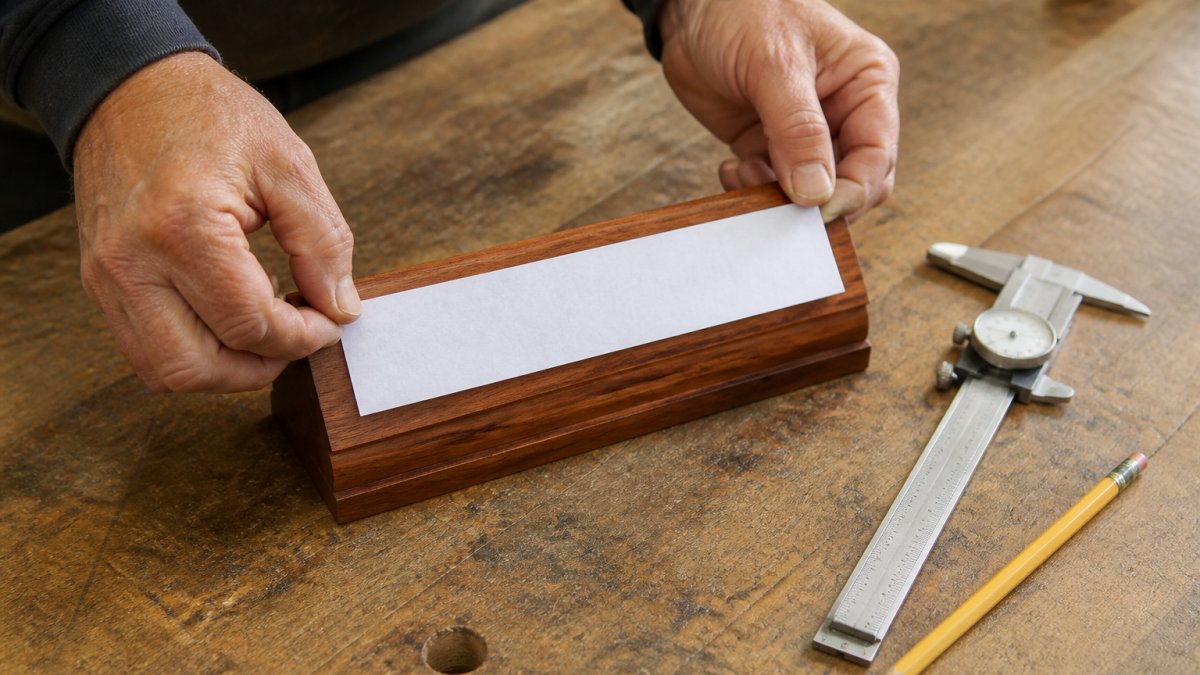
Font and layout choices decide whether the engraving reads clearly at a glance. Simple, clean fonts engrave best on wood. Thin script fonts and tiny serifs blur into the grain and lose contrast.
Keep these rules in mind:
Desk Name Plate 0 - 9 letters →
- Minimum size: lettering below a comfortable reading size loses definition on wood
- Spacing: leave breathing room between letters and around the edges
- Placement: center the design and keep it clear of knots and edges
- Contrast: darker woods hide engraving, so darker burns read better on light wood
For a desk name plate, layout matters most. A long name needs a wider plate, and a short one can look lost on a big surface.
Test Engraving on a Sample Piece: Power, Speed and Contrast
A test engraving on a sample piece is a practical way to dial in laser power and speed. Every wood species burns differently, so settings that work on maple can scorch olivewood or under-burn cocobolo.
Run a small test grid on scrap of the same species before touching the real piece. Adjust two things:
- Power: too high burns and darkens edges; too low leaves a faint, shallow mark
- Speed: slower cuts deeper and darker; faster stays light and shallow
Check the result for even depth, clean edges, and good contrast. Watch for burn marks and uneven engraving. If the test looks patchy, the wood grain or a hidden knot is fighting you.
Personalized Gift Return Policy Expectations and Fixing Mistakes
Personalized gift return policy expectations are tricky because engraved items usually can't be resold. Custom pieces are generally treated as final sale unless the error is the maker's. That's exactly why proofing matters so much. But when a mistake does slip through, the real question is not just who pays, it's whether the piece can be saved, and how.
Match the fix to the error
Work through these questions before promising a customer anything:
- Wrong name, wrong date, or misaligned design that the customer did not approve: this is a production error. Remake or refund, no argument. Do not attempt to repair a wrong name, sanding and refilling rarely hides lettering cleanly on a finished gift.
- Customer-approved mistake, such as a misspelled name they signed off on: the approved proof is the contract. Offer a discounted remake and explain that the original proof was confirmed. Most customers accept this when the proof record is clear.
- Faint or shallow engraving: re-engrave deeper if the surface allows. Check that the original depth left enough material; a second pass on an already-deep cut can blow out the edges.
- Small slips, stray marks, or a single wrong character: fill and refinish where the wood permits. This works best on raw or lightly oiled wood; lacquered and stained surfaces are much harder to blend invisibly.
- Cracked or chipped blank: do not try to fill structural damage on a gift. Remake it.
When sanding and refinishing actually work
Sanding out an engraving is realistic only when the mark is shallow and the surrounding finish can be matched. On solid hardwood with an oil or wax finish, a light sanding followed by re-oiling can blend a small slip.
A practical rule: if the repair would be visible from arm's length, remake the piece. A gift that looks patched defeats the purpose of a personalized item.
Set expectations before the order
If you want more gift ideas to apply all this to, browse these personalized wooden office gifts for men for inspiration.
Ordering a Custom Desk Name Plate From Wooden Concepts
A desk name plate is one of the easiest personalized wooden gifts to get right, and one of the most visible when it goes wrong.
Pick the product that matches your letter count:
- Desk Name Plate 0 - 9 letters for short names
- Desk Name Plate 1 - 9 Letters for standard names up to nine characters
Each plate is 2 inches deep and 2 inches tall, and a normal 10-letter name runs about a foot long. Plates can be made as long as 4 feet.


Here are the key specs for Wooden Concepts desk name plates.
| Item | Value | Note |
|---|---|---|
| Material | Solid mahogany | With a lacquer finish |
| Depth | 2 inches | , |
| Height | 2 inches | , |
| Length for a normal 10-letter name | About a foot long | , |
| Maximum length | 4 feet | Plates can be made as long as 4 feet |
| Short-name plate | Desk Name Plate 0 - 9 letters | For short names |
| Standard-name plate | Desk Name Plate 1 - 9 Letters | For standard names up to nine characters |
Frequently Asked Questions
How can I avoid spelling mistakes on a personalized wooden gift?
Type the name or message into a plain document first, then read it aloud and spell it letter by letter. Check punctuation, capitalization and any dates against the original source, not your memory. Ask a second person to read the approved proof before production starts. On personalized wooden gifts, a misspelled name usually cannot be sanded out without leaving a visible patch, so the cheapest fix is catching it before the engraving begins.
Can an engraving mistake be fixed after it happens?
Sometimes. Shallow errors on raw wood can be sanded back and re-engraved if the grain allows it. Deeper burns or mistakes on stained or lacquered surfaces are harder to hide, and filling an engraved area rarely matches the surrounding wood. For a personalized gift, the practical route is often a remake rather than a repair. Confirm with the maker what they can rescue before you assume the piece is lost.
Does the type or grain of wood affect how an engraving looks?
Yes. Dense exotic woods such as cocobolo and bocote hold fine lettering well, while burls and heavily figured pieces can have grain that competes with small text. Knots and darker streaks can swallow contrast, so check the blank before engraving and shift the layout away from defects. A test engraving on a sample piece of the same species shows how much contrast and depth you will actually get.
What should I do if a personalized wooden gift arrives with an error?
Photograph the item and the packaging, then contact the seller within their stated window with your order number and the approved proof. Most makers distinguish between their own production errors, which they remake, and customer-approved details, which are usually the buyer's responsibility. Read the personalized gift return policy expectations before ordering so you know which side a misspelled name falls on, and keep the proof email as your record.
Getting a personalized wooden gift right comes down to one habit: slow down before the machine starts. Confirm every customer detail, test on a sample, and get a signed proof. Wooden Concepts has spent 30 years turning exotic woods into heirloom pieces, with custom engraving and a choice of wood and metal finishes on many items. Get started with Wooden Concepts and order a custom desk name plate that arrives exactly as you approved it.
